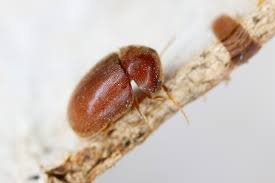
Proper pest management relies heavily on early detection, rapid response, and accurate species identification. When managing stored product pests in residential or commercial storage spaces, recognizing the Cigarette Beetle (煙甲蟲) early can prevent extensive contamination of valuable goods. Measuring just a few millimeters in length, these resilient insects cause significant economic losses annually by infesting dry goods, spices, botanicals, and tobacco. Let us explore the critical data, behavioral statistics, and primary questions surrounding the early detection of these destructive pests.
What are the exact physical dimensions and characteristics?
Identifying this specific pest requires close visual inspection, as they are frequently confused with drugstore beetles. Adult specimens typically measure between 2.0 and 3.0 millimeters in length. They feature a distinct reddish-brown coloration and a stout, oval-shaped body. When viewed from a side angle, the head is bent downward nearly at a right angle to the body, giving the insect a distinctively humped appearance. Their antennae are serrated, resembling the teeth of a saw, which is a key identifying marker for pest control professionals.
Which environments show the highest statistical probability of infestation?
Temperature and humidity play a massive role in the proliferation of these insects. Statistical observations indicate that populations thrive in environments where temperatures consistently remain between 65 and 90 degrees Fahrenheit. Furthermore, higher humidity levels dramatically accelerate their development. You will most commonly find them clustered in pantries, food processing facilities, and warehouses. They actively target paprika, pet food, dried floral arrangements, and grain-based products. If your facility maintains high ambient temperatures, the risk factor for a rapid population spike increases exponentially.
What numerical data defines their reproductive cycle?
Understanding the biological timeline of this pest is critical for effective eradication. A single adult female can lay anywhere from 10 to 100 eggs over her short lifespan of two to four weeks. Under optimal warm conditions, these eggs hatch in just six to ten days. The resulting larvae, which are responsible for the vast majority of product damage, will feed continuously for five to ten weeks before entering the pupal stage. Because the entire life cycle can be completed in just 40 to 90 days, a minor localized issue can escalate into a severe facility-wide problem in less than three months.
What are the primary visible indicators of their presence?
Because the adults are strong flyers and are highly attracted to light, you will often find them near windows or illuminated light fixtures during the late afternoon and early evening hours. However, the most definitive proof of an active issue is the damage left behind. Inspect your packaging for perfectly round pinholes; the adults chew these exit holes as they emerge from the pupal stage. You may also notice a fine, powdery substance accumulating at the bottom of storage containers or shelving units, which consists of food debris and insect frass.
How can professionals systematically monitor for these pests?
Relying on visual inspections alone is often insufficient for early detection. The deployment of pheromone traps provides measurable, quantitative data regarding the severity and exact location of a localized population. By placing these traps in a grid pattern across a storage facility, professionals can track capture rates over a 24-to-48-hour period. A sudden spike in captured adults within a specific quadrant allows facility managers to isolate the contaminated goods immediately, preventing the insects from spreading to adjacent, uninfected inventory.
Taking Decisive Action Against Pantry Pests
Identifying a structural or pantry infestation quickly is the only reliable method to mitigate property damage and reduce product waste. By understanding the statistical life cycle, tracking the physical warning signs, and utilizing data-driven monitoring tools, facility managers and homeowners alike can address the issue before it multiplies out of control. Always prioritize consistent environmental monitoring and rapid disposal of compromised goods to maintain a safe, sanitary, and pest-free space.